
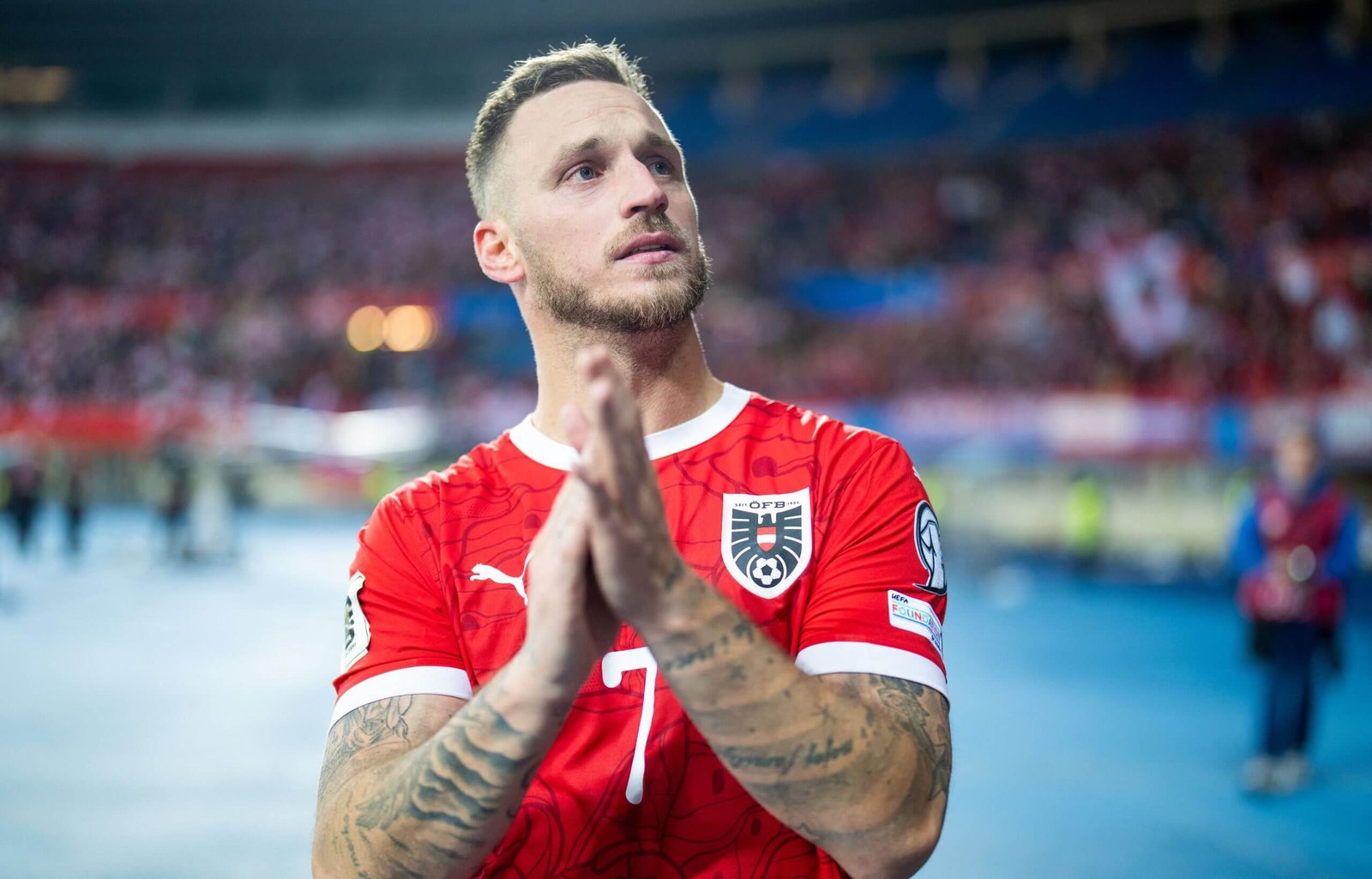
Ralf Rangnick has announced his 26-man Austria squad for the 2026 FIFA World Cup™, as Die Mannschaft prepare to end a 28-year absence from football’s greatest stage. Austria will make their first appearance at the global finals since France 1998, thanks to a dramatic qualifying campaign that went down to the wire.
Alaba, Arnautović Lead Experienced Core
National icon David Alaba headlines the squad. The Real Madrid defender, who has battled back from serious injury to regain his fitness just in time for the tournament, will captain Das Team in what is likely his final World Cup appearance. His leadership, tactical intelligence, and versatility remain indispensable to Rangnick’s high-intensity system.
Fellow experienced heads Marko Arnautović, Michael Gregoritsch, and Marcel Sabitzer have also been included. Arnautović, now plying his trade in Serie A, brings a potent mix of physicality, technical skill, and temperamental edge. Gregoritsch, the hero of Austria’s qualifying finale, offers a proven goal threat off the bench or as a starter. Sabitzer, the Borussia Dortmund engine, provides box-to-box energy and big-game experience.
Goalkeepers
| Player | Club |
|---|---|
| Alexander Schlager | Red Bull Salzburg |
| Niklas Hedl | Rapid Vienna |
| Patrick Pentz | Brøndby |
Defenders
| Player | Club |
|---|---|
| David Alaba (Captain) | Real Madrid |
| Stefan Posch | Bologna |
| Philipp Lienhart | Freiburg |
| Gernot Trauner | Feyenoord |
| Maximilian Wöber | Leeds United |
| Kevin Danso | Lens |
| Andreas Ulmer | Red Bull Salzburg |
| Flavius Daniliuc | Salernitana |
Midfielders
| Player | Club |
|---|---|
| Marcel Sabitzer | Borussia Dortmund |
| Konrad Laimer | Bayern Munich |
| Nicolas Seiwald | RB Leipzig |
| Carney Chukwuemeka | Chelsea |
| Paul Wanner | Bayern Munich (on loan) |
| Xaver Schlager | RB Leipzig |
| Florian Grillitsch | Hoffenheim |
| Christoph Baumgartner | RB Leipzig |
Forwards
| Player | Club |
|---|---|
| Marko Arnautović | Inter Milan |
| Michael Gregoritsch | Freiburg |
| Karim Onisiwo | Mainz |
| Sasa Kalajdzic | Wolves |
| Junior Adamu | Freiburg |
| Marco Grüll | Rapid Vienna |
| Andreas Weimann | West Brom |
New Allegiances: Chukwuemeka and Wanner In
In a significant boost to Austria’s midfield creativity, Carney Chukwuemeka and Paul Wanner have both been included after switching their international allegiances this past March.
- Carney Chukwuemeka, born in Austria to Nigerian-British parents, previously represented England at youth levels. The attacking midfielder, currently at Chelsea, brings dribbling ability, close control, and a progressive passing range that could unlock deep-lying defenses.
- Paul Wanner, who had featured for Germany’s youth sides, opted to represent his country of birth. The Bayern Munich loanee (currently impressing in the Bundesliga) is seen as one of Europe’s most promising teenage playmakers. His inclusion signals Rangnick’s desire to blend youth with experience.
Both players committed to Austria in a high-profile dual-nationality swoop that has energized the squad and added depth to a midfield that will need creativity at the World Cup. (Source: fifa.com)
The Road to 2026: A Thrilling, Nerve-Shredding Qualifying Campaign
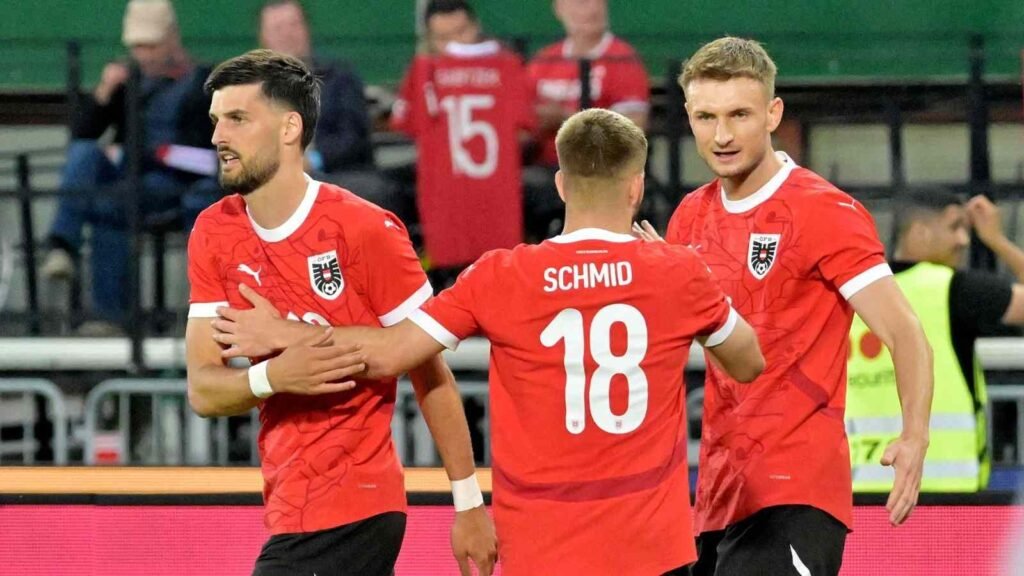
Austria’s path to the World Cup was anything but straightforward. For much of the campaign, Rangnick’s charges looked destined to cruise to qualification. Five straight wins placed them top of Group H with just three matches to play, and talk of a first World Cup this century began to build into genuine expectation.
But football has a cruel sense of drama. A late, gut-wrenching defeat to Romania halted that momentum abruptly. Suddenly, the mathematics tightened. Rangnick recalibrated his side, and they responded with a composed victory over Cyprus in their penultimate match, leaving them within a single point of automatic qualification. However, Bosnia and Herzegovina also won their fixture, setting up a winner-takes-all grandstand finale in Vienna.
The Decider: Austria vs. Bosnia and Herzegovina – Vienna, November 2025
The Ernst-Happel-Stadion was a cauldron of noise and anxiety. Over 48,000 fans packed the stands, knowing that a win would send Austria to the World Cup; anything less would leave their fate in the hands of other results.
Disaster struck early. Just 12 minutes in, Haris Tabaković – a striker with a poacher’s instinct – latched onto a loose ball inside the Austrian box and fired the Dragons into a 1–0 lead. The home crowd went silent. Bosnia, organized and physical, had the perfect away goal.
What followed was 65 minutes of sustained Austrian pressure. Rangnick’s system, a relentless 4-2-2-2 press, pinned Bosnia deep inside their own half. Shot after shot rained down on the Bosnian goal. Arnautović hit the post from 12 yards. Sabitzer saw a curling effort tipped over. Chukwuemeka, introduced just after the hour, weaved through the box only to see his close-range strike blocked by a lunging defender.
Bosnia’s rearguard, marshaled by veteran center-backs and a goalkeeping performance for the ages, refused to break. Every cross was headed clear. Every second ball was hacked into the stands. The clock ticked past 70 minutes. Hope began to drain from the stands.
Then, in the 77th minute, chaos.
A corner from the right was only half-cleared. Sabitzer recycled the ball back into the mixer. A header was blocked. Another shot ricocheted off a Bosnian shin. The ball pinballed around the six-yard box off a post, off a keeper’s glove, off a defender’s heel. And there, lurking with the instincts of a born goalscorer, was Michael Gregoritsch.
The big forward, who had been on the pitch for less than ten minutes, threw his right boot at the bouncing ball and bundled it over the line. The Ernst-Happel-Stadion erupted. Pandemonium. Players slid on soaking wet turf. Rangnick, usually composed, punched the air and embraced his staff. The equalizer made it 1–1, and with results elsewhere holding, that single point was enough.
Österreichischer WM-Kader 2026
Rangnick, the godfather of German pressing football, has transformed Austria into a disciplined, energetic, and tactically flexible outfit. Expect a high defensive line, aggressive counter-pressing, and a midfield that hunts in packs. While not among the pre-tournament favorites, Austria will be no one’s idea of a soft draw. With Alaba’s composure at the back, Sabitzer’s engine in midfield, and Arnautović’s unpredictable brilliance up front, Das Team have the tools to trouble any opponent.
After 28 years in the wilderness, Austrian football is back. And they’ve arrived with a story worth telling.
Read More: