
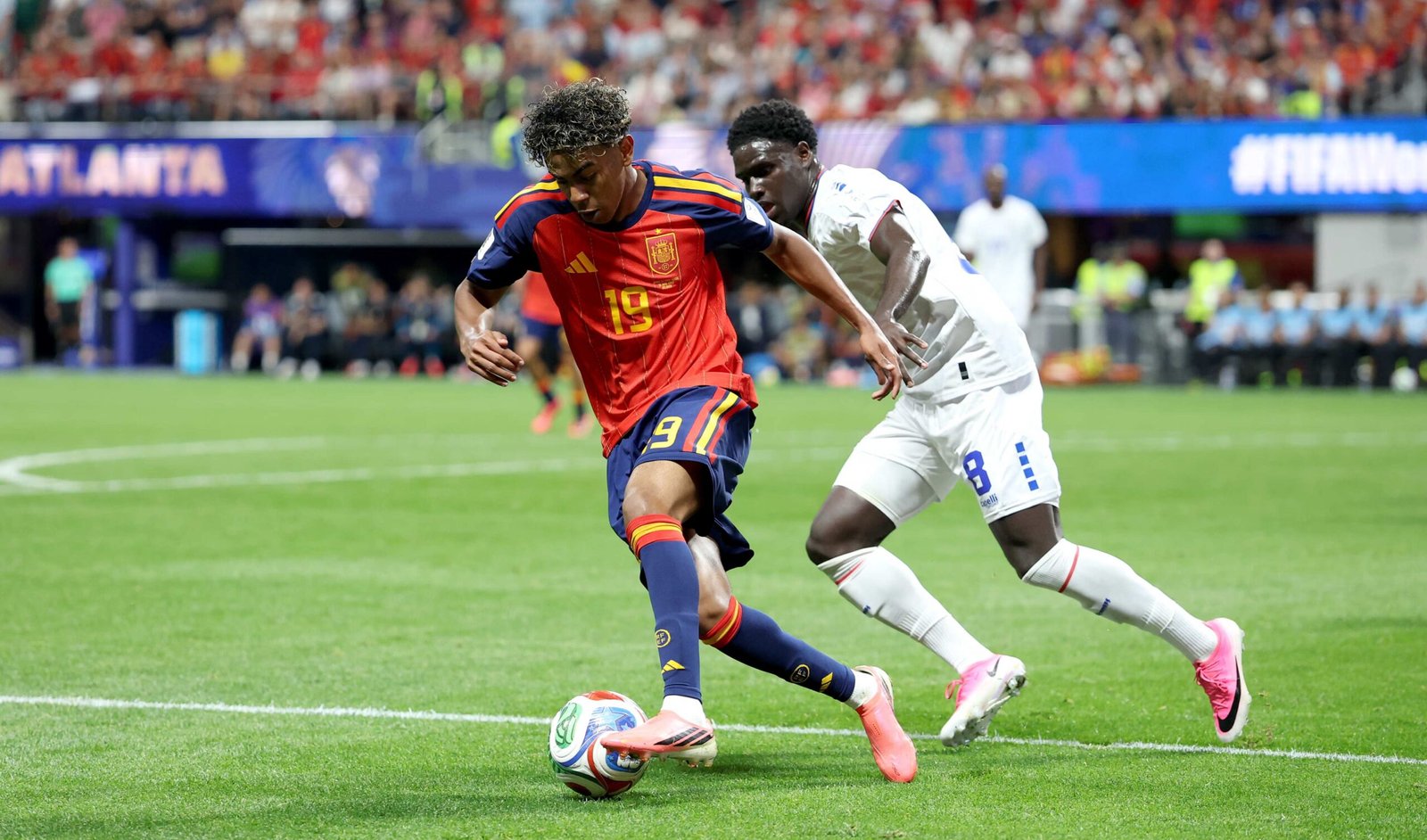
In a match that will be dissected by tacticians for years to come, Spain produced one of the most statistically dominant performances in World Cup history yet walked away with nothing but a solitary point. The 0-0 draw against Cape Verde was not merely an upset it was a footballing paradox that defied logic, probability, and the very essence of how we measure control in modern football.
The final whistle sent shockwaves through the Atlanta Stadium. Spain’s players stood with hands on hips, staring blankly at the scoreboard. Cape Verde’s squad collapsed in a heap of exhausted celebration. The Blue Sharks, ranked 73rd in the world, had just held the 2010 world champions to a goalless draw on the biggest stage.
First Half: The Siege Begins
From the opening kickoff, Spain imposed their will with suffocating intensity. Pedri and Gavi orchestrated the midfield with metronomic precision, while Lamine Yamal and Nico Williams tormented the flanks. By the 15th minute, Spain had already completed more passes (112) than Cape Verde would manage in the entire first half.
The first clear chance arrived in the 12th minute. Yamal’s mazy run from the right flank ended with a low cross that found Álvaro Morata six yards out. The captain’s first-time shot was destined for the bottom corner until Josimar Oliveira Cape Verde’s hero in goal dived sharply to his left, palming the ball around the post.
Spain’s corners became a recurring threat. By halftime, they had won seven corners to Cape Verde’s zero. Each delivery caused panic in the box, but the Blue Sharks’ defense, led by the towering Stopira and resilient Roberto Lopes, threw bodies in the way of every attempt.
The closest Spain came in the opening period was when Rodri’s thunderous 30-yard strike crashed against the crossbar in the 38th minute. The collective gasp from 71,000 spectators echoed around the stadium as the ball bounced down onto the goal line and was hacked clear by a desperate Cape Verdean boot.
Second Half: Frustration Mounts
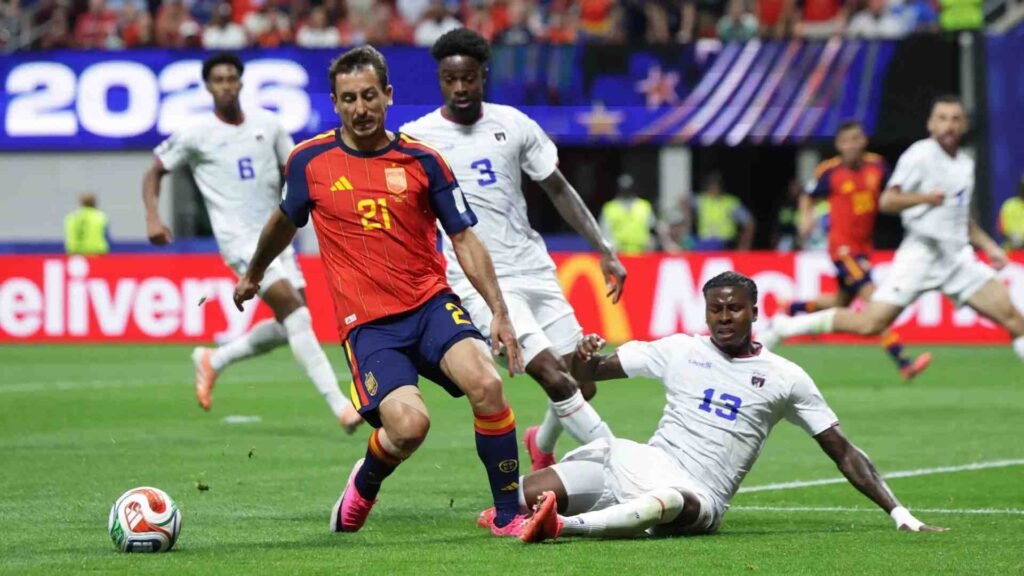
Spain emerged with renewed urgency. De la Fuente had clearly demanded more penetration, and his players responded. The intricate passing patterns became more direct. The full-backs, Marc Cucurella and Dani Carvajal, pushed higher, effectively turning Spain into a 2-3-5 formation in attack.
In the 52nd minute, Pedri produced a moment of magic a chipped through ball that dissected the Cape Verde defense perfectly. Morata was through on goal, one-on-one with Oliveira. The striker attempted to round the goalkeeper, but Oliveira read the move brilliantly, smothering the ball at Morata’s feet. It was a save that would define the night.
Cape Verde’s resilience was not passive. While managing just 25% possession, they pressed with extraordinary discipline. Their 398 pressing actions dwarfed Spain’s 200, a statistic that reveals their defensive intensity. Every Spanish pass was contested. Every receiving player was immediately closed down. The Blue Sharks were not merely defending they were hunting.
Spain continued to create. Ferran Torres, introduced as a substitute in the 60th minute, immediately tested Oliveira with a curling effort from the edge of the box. The goalkeeper tipped it over spectacularly. From the resulting corner, Aymeric Laporte’s powerful header was brilliantly saved by Oliveira, who somehow got a fingertip to a ball heading for the top corner. (FIFA.com)
How does a team with 27 attempts, 16 inside the box, and 11 corners fail to score?
The answer lies in Cape Verde’s defensive organization. Their backline maintained an almost perfect offside trap, catching Spain offside three times. Their midfield, led by the indefatigable Kevin Pina, consistently disrupted Spain’s rhythm. And Oliveira produced one of the great World Cup goalkeeping performances—seven saves, many of world-class quality.
Match Statistics
| Category | Spain | Cape Verde |
|---|---|---|
| Possession | 65% | 25% |
| Possession Contest | 10% | 10% |
| Shots Total | 27 | 6 |
| Shots On Target | 7 | 1 |
| Shots Off Target | 11 | 4 |
| Corners | 11 | 1 |
| Yellow Cards | 1 | 1 |
| Red Cards | 0 | 0 |
Cape Verde’s Tactical Masterclass
Pedro Leitão Brito’s tactical plan was audacious in its simplicity: absorb, resist, and counter when possible. Cape Verde only attempted six shots, but each carried the threat of a smash-and-grab winner.
Their solitary on-target effort came in the 73rd minute. A rare counter-attack saw Jovane Cabral sprint clear down the right. His cut-back found Bebé in space, but the former Manchester United forward’s shot was straight at Unai Simón a reminder that Cape Verde were not merely surviving but living for a moment of magic.
Cape Verde’s 64 completed line breaks from 132 attempts show they were not afraid to pass through Spain’s press. Their 115 receptions in between Spain’s lines frustrated La Roja’s high defensive line. They received the ball in dangerous pockets, forcing Spain’s defenders to drop deeper and deeper.
Possession & Distribution
| Category | Spain | Cape Verde |
|---|---|---|
| Total Passes | 811 | 306 |
| Passes Completed | 755 | 227 |
| Pass Completion % | 93% | 74% |
| Crosses | 39 | 3 |
| Crosses Completed | 8 | 2 |
| Cross Completion % | 21% | 67% |
| Switches of Play Completed | 8 | 2 |
The Psychological Battle
As the match wore on, Spain’s body language shifted. The fluid passing became labored. The urgency turned to desperation. Players began shooting from distance 11 attempts came from outside the box, a sign of frustration when faced with a packed defense.
Cape Verde, conversely, grew in confidence. They committed tactical fouls to break Spain’s rhythm 10 fouls against compared to just one from Spain and used every opportunity to waste precious seconds. Their yellow card, shown to defender Steven Furtado in the 78th minute, was a small price to pay for disrupting yet another Spanish attack.
The minute of injury time saw Spain’s final assault. A floated cross found Robin Le Normand at the far post, but his header sailed wide. The referee’s whistle prompted scenes of jubilation from the Cape Verde bench—a point that felt like a victory.
Disciplinary & Fouls
| Category | Spain | Cape Verde |
|---|---|---|
| Yellow Cards | 1 | 1 |
| Red Cards | 0 | 0 |
| Fouls Committed | 1 | 10 |
| Fouls Against | 10 | 1 |
| Offsides | 2 | 3 |
| Free Kicks | 4 | 12 |
Post-Match Reactions
Luis de la Fuente (Spain Head Coach):
“I have never seen a performance like this that didn’t produce a goal. We did everything except score. But credit to Cape Verde they defended with their lives. Oliveira produced saves you only see in highlight reels. We must regroup. Football can be cruel.”
Pedro Leitão Brito (Cape Verde Head Coach):
“My players are heroes. This is the greatest result in our football history. We respected Spain but never feared them. We had a plan and executed it perfectly. Josimar will be celebrated in our country forever. This point gives us belief for everything still to come.”
Josimar Oliveira (Cape Verde Goalkeeper):
“I don’t know what to say. I still can’t believe it. I told myself before the game: ‘This is your moment.’ Every save, I was thinking of my family, my country. This is for every Cape Verdean around the world.”
Group H Implications
The result sends a shockwave through the group. Cape Verde sit level on points with the group favorites, while Spain face unexpected pressure. Their remaining matches must be won, and the shadow of this stalemate will hang over their preparations.
For Cape Verde, the dream continues. A point against one of the world’s elite teams could be the foundation upon which a historic qualification is built. The Blue Sharks have proven they belong on the biggest stage.
FIFA World Cup 2026 Match Schedule & Group Table are here.